Friday, March 12, 2010

Don Alonso De Villanueva


My mother was not ill-spoken person . In her mouth rude inconceivable. Except, I must confess with shame, when there in my teens I discovered a hydraulic strategy to extract, automatically, a sonic "fuck." I watchtower that she was in the shower, and for a split second he opened the cold water tap or water hot kitchen sink. The immediate effect was that, during the same time, suddenly altered the careful thermal balance of the shower ... and my own mother was eager to lower the mother! Since the domestic level onwards, the 'removed' from the water touches the heartstrings of people. [...]

According to the National Water Study (NSS) 2005, quoted by the Comptroller in his report on the state Natural Resources and the Environment 2007-2008, the 'production 'water by the Colombian ecosystems or an average of 47,470 meters cubic meters per person y por año (casi 47 millones y medio de litros), cantidad aparentemente enorme pero que, de acuerdo con la misma fuente, podría reducirse a 1.890 metros cúbicos por persona y por año alrededor del 2020, si no se adoptan y ejecutan las decisiones adecuadas. ¡Esto es 26 veces menos disponibilidad de agua por persona y por año!

Si hoy tenemos en Colombia los niveles de conflicto que tenemos ¡Imagínense como serán cuando estemos 26 veces menos bañados!

Ver la versión completa en la revista CARRUSEL

Thursday, March 11, 2010

Josh Hutcherson Herpes

growth and form of D'Arcy Thompson - Books about evolution - II


This wonderful book of D'Arcy Wentworth Thompson (1860-1948) provides a vision for growth and living way that clashes with the evolutionary paradigm. The author wrote the book in 1917, then in 1942 it expanded to reach 1,116 pages wound. At the moment I found only one edition in Castilian, but small, this version to condense the text, eliminated entire sections relating mainly to vegetables.
D 'Arcy Thompson shows with thousands of examples of how living things have little or nothing to do with their genes-proteins. Environmental conditions, the laws of physics, chemistry, gravity (in general all laws of nature) and the growth parameters shape the way of being.
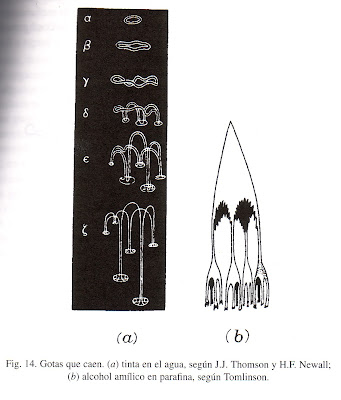
Start with simple examples on how unicellular organisms, in the shape of the zygote and morula, in the shape of the leaves, corresponding to logarithmic growth of arithmetic series, in the form of jellyfish, mainly due to physical laws governing the membranes separating two liquids of different densities, such as jellyfish have to be "pockets of liquid-viscous" surrounded by water, suggesting in this case, a simple experiment with water and ink which causes forms of jellyfish.

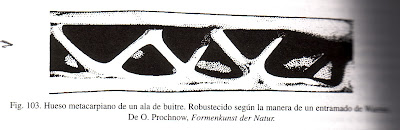
speaks of the growth of horns, claws and fangs and its various curls. Profusely says the bony structures of mammals and reptiles, showing countless examples and figures like the skeleton of quadrupeds is constructed in a similar way to how Engineers build large steel bridges. Study
inner trabecular bone, which are built specifically to withstand the kind of physical effort to be supported. Quote

other scientific experiments, experiments that really matter, and generally muted, such as those made with planktonic foraminifera, which was added a few drops of alkali to the water in which lived, and built the shells exactly like those of other species.
And much more. The author was a true scholar, not merely the empirical sciences, masterfully dominated the philosophy, history, engineering, and literature.
This is a very enlightening book that I highly recommend to those interested in seeking the truth about how living things, this book offers a range of research to be done.
D 'Arcy Thompson "On Growth and Form" Editing John Tyler Bonner, published by Cambridge University Press. Madrid, from 2,003 to 325 pages.

Semogil March 12, 2010